(item number) 1032
(title) Marusan Standard Size Soft Vinyl Namegon
(maker) Marusan
(the date of issue) 1966
(Material) Soft vinyl
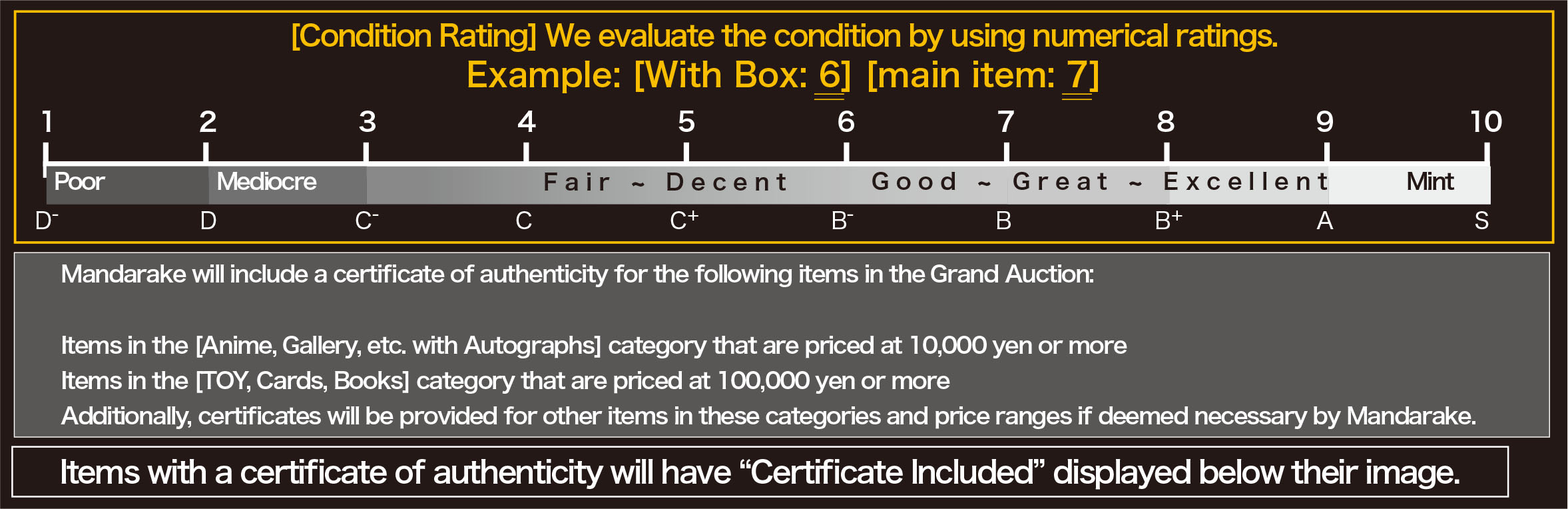
(detailed) Main item 8 (paint wear, slight sun discoloration)
(starting bid price) 550,000 yen
(comment) In 1966, Marusan released Ultraman Q kaiju soft vinyl figures. At first there were concerns about sales, but combined with children’s popularity for monsters, playacting, and the vinyl’s resistance to breakage, orders from wholesalers and retailers increased dramatically. Against that background, Marusan increased production of soft vinyl figures, and in July 1966, to coincide with the broadcast of Ultraman, they newly released Namegon, Daimajin, Godzilla, Baragon, and Ultraman kaiju. Namegon was released at that time, and although it was an Ultra Q kaiju, it was not the very first kaiju released. As for that Namegon, its manufacturing method was distinctly different from the other kaiju soft vinyl figures. Usually soft vinyl is removed from a mold to manufacture it, but this Namegon was not made with a pull mold: it was a split mold using two metal mold halves. Because of that, the eyeball parts have a parting line, and there are traces of burr removal at the joints where the eyeballs and body meet the bottom surface. Also, because this process differed from the usual method of removing soft vinyl from a mold and took more effort than expected, Namegon was not released during the later Bullmark period. The Namegon offered this time shows some slight yellowing and age-related deterioration, but much of the silver paint on the back remains, and some remains on the front fin as well. The fragile glued-on eyes-a distinctive feature of Marusan Namegon-are still firmly intact. When attaching the eyes, the eyeholes are punched out of the main body with a hole punch, but fragments of that soft vinyl remain (Miyagawa).
[Verification Report on the "Phase 1 / Phase 2" Classification in Namegon Standard Soft Vinyl]
*Overview of the verification
At our company, we conducted a comprehensive examination of all Namegon standard soft vinyl specimens that we have possessed or handled to date, covering elements such as sculpting, paintwork, and weight.
As a result, we confirmed that the features traditionally considered characteristic of "Phase 1" and "Phase 2" do not consistently correspond to specific production periods, but are complexly intermingled on an individual basis.
Specifically, we confirmed multiple specimens with the following characteristics: * Specimens with carefully painted whiskers yet relatively heavy weight * Specimens with simplified whisker painting yet relatively light weight * Specimens that are lightweight but have coarse silver paint on the back
From these cases, there was no tendency to clearly divide production periods by particular characteristics.
Based on the above verification results, our company has concluded that "for Namegon standard soft vinyl, there was no clear temporal division corresponding to the so-called 'Phase 1 / Phase 2'."
Below, we describe the basis for this conclusion by item.
*On the depiction of whiskers
Traditionally, "short, neatly painted whiskers" have been cited as a characteristic of "Phase 1."
It cannot be denied that, in the early stages of production, relatively careful painting work may have been performed.
However, considering the production system at the time, it is assumed that painting was done manually by multiple workers. In that case, it is natural that differences in skill and work habits among workers would lead to individual variation in the length of the moustache and the precision of its depiction. Given that production had been increased in response to growing demand for vinyl monster figures, we judged it highly likely that these worker-to-worker differences manifested directly as product variation. *About the silver paint: A similar tendency was observed for the silver paint applied from the back to the fins. It has sometimes been explained that "the first batch had finer silver paint particles and the coating was uniform from the back to the fins," but in reality there is considerable individual variation in the finish of the silver paint. The appearance of silver paint changes greatly depending on the state of agitation of the metallic powder and the conditions during application, which affects the coarseness of the particles and the overall impression of the coating. Therefore, we determined that it is difficult to establish the production period based solely on the condition of the silver paint from an objective verification standpoint.
*About weight
As a result of measuring items in our inventory, we confirmed a range of approximately 90 g to about 105 g.
In soft vinyl products, the thickness can vary depending on factors such as firing time, temperature control, and how the material flows in the mold during the process of pouring material into the mold and firing. These processes rely heavily on manual management, so it is entirely plausible that specimens produced at the same time could show differences in weight. Therefore, we concluded that it is not appropriate to clearly divide production periods based on weight differences. Regarding verification of the molds: among our inventory there were multiple specimens that had identical-sized and identical-shaped indentations in the same location on the head. These indentations are thought to be caused by foreign matter attached to the mold, but even among the specimens sharing this feature, differences were observed in weight, beard depiction, and the condition of the silver paint. If one were to distinguish "Period 1" and "Period 2" based on weight or paint condition, that would imply different production times for specimens originating from the same mold, resulting in a lack of logical consistency. In addition, no significant differences were found in the modeling or size of the hump on the back, and based on our verification we judged that the same mold was used throughout the production period. There was thought to be no temporal difference due to mold changes.
*Conclusion
It is a fact that individuals possessing all the elements previously considered "traits of the first generation" do exist. However, on the other hand, many specimens were also found whose characteristics did not match - for example: * some are lightweight but have rough beard detailing and simplified silver paint, * some are heavy but have meticulous beard detailing and rough silver paint. It is presumed that when Namegon was released, Marusan was forced to rapidly increase production in a short period due to a sudden surge in orders from wholesalers and retailers. As a result, production was carried out manually by many workers, and variations in the process likely manifested as individual differences. The coloring of the beard and back was consistently white or silver, and since no changes were found in the sculpt molds, we concluded that there is no reasonable basis to clearly distinguish production periods based on specific features.
132UltraKaiju
z132 |